Threads of Change
Threads of Change: Slow fashion makers and textile outfits are shifting what it means to care about what we wear



In a dingy warehouse tucked in a rural pocket of West Asheville, Lea Panteliodis’s sewing studio brims with rolls of deadstock denim and other fabrics, spools of thread, bins of heavy-duty snaps, and a horde of vintage sewing machines—20 to be exact. From 1920s Singers to Union Specials, each heavy, metal beast fulfills a distinct stitching role. A long table holds a handful of cut fabrics waiting to be sewn together to create selvedge denim jeans, rockabilly shirts, and jackets—all utilitarian, work wear-inspired styles of the 1960s—which she makes and sells under the brand Twin Denim Co.
Her operation is intentionally small-scale, in direct contrast to mass fashion production. Rather than an assembly line, Panteliodis bounces between projects, working on whatever excites and motivates her next. "Whenever I get tired of working on a pair of pants, I just go work on something else. It’s the antithesis of being in a factory," she says. It takes her about six hours to make just one pair of jeans, which retails for $350. That may seem costly to some, but considering the quality and durability of the materials and equipment she’s using, not to mention her time, she argues it’s an investment in a custom garment that’s made to last.
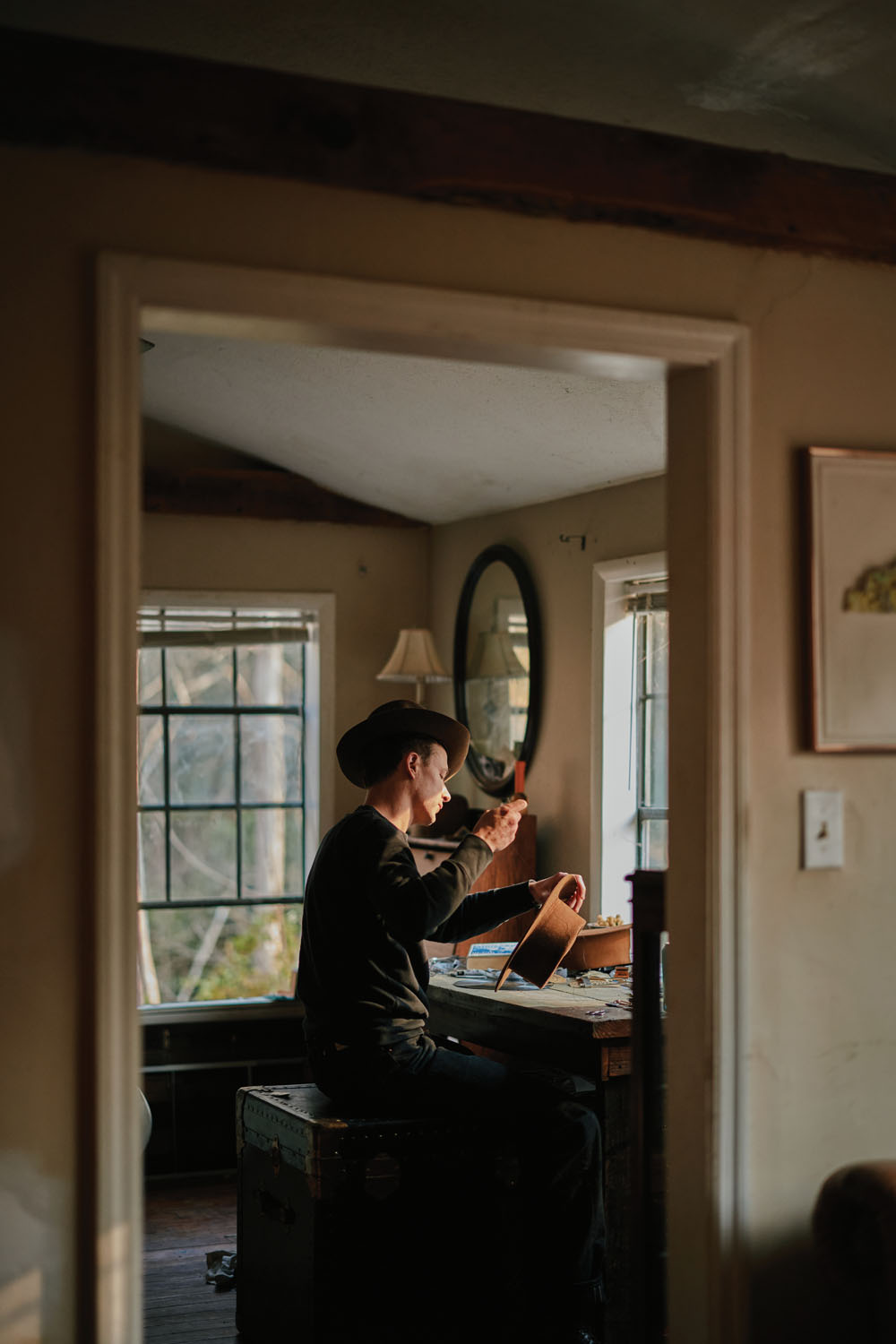
About 30 minutes north along the French Broad River in Marshall, Ty Thomas adheres to a similar approach with his hats, made under the name Appalachia Blues. Inspired by his love for old blues music, the line hearkens to the trilby and gambler silhouettes of the 1920s and ’30s, and each is custom-made for the individual client. It’s a handsome, timeless look that has garnered the attention of acclaimed musicians like Billy Strings and John Butler as well as the film industry. A handful of stars even donned his headpieces in the 2021 Oscar-winning movie Ma Rainey’s Black Bottom, set in 1927 Chicago.
But Thomas doesn’t consider himself a fashion designer. Like most makers, he was drawn to the process and craftsmanship. A self-taught hatter, he entirely handcrafts each custom piece with quality felt and leather, using antique tools for sizing, cutting, shaping, and finishing. “I could make my hats from start to finish without electricity if I had to,” he says. Thomas admits he could use new tools, but he appreciates the character and integrity behind doing things the old way. He estimates he spends a total of 24 hours spread over the course of a week to make a single hat, which sells for $400 to $600—a price he says is a solid investment for something you’ll have for the rest of your life. “My hats are completely made for function,” he says. “They may be fashionable, but I personally wouldn’t consider it like that. I think fashion is temporary. Function and style are forever. My hats are made to last hundreds of years.”
The Expense of Cheap Fashion
From a business perspective, this high-dollar, long-lasting approach to wearable products may not seem like a smart model—intentionally reducing the need for repeat purchases. But prioritizing quality over quantity for the purpose of longevity and timeless looks over trends are the very foundations of what’s known as slow fashion, a social movement that’s been bringing a mindful approach to clothing production and consumption since roughly 2007. It’s an ethical choice that some brands, designers, and consumers gravitate toward for the sake of people and our planet.
For makers and manufacturers, it’s about sourcing low-impact materials and supply chains that minimize environmental impact while prioritizing fair wages and conditions for workers. Slow fashion is also about reducing the amount of textile waste that winds up in our landfills. For the consumer, it’s about buying fewer garments less often, being mindful of the resources and processes behind the clothes you purchase, and choosing secondhand or quality goods that last longer and reduce waste.
This is all contrary to the large-scale environmental and social side effects of fast fashion. Over the past 25 years, apparel has become one of the most polluting industries in the world. It’s estimated that between 80 and 150 billion items of clothing are produced each year, much of that by workers whose wages fall below the poverty line. That’s been driven by a large jump in consumption thanks to cheap prices. According to the United Nations Environment Programme, “the average person is buying 60 percent more clothing than 15 years ago, while each item is kept for only half as long.” Those numbers are based on a study from 2016; since then, mass consumption and throwaway culture have only increased. An estimated 92 million tons of clothing end up in landfills each year. “To put things in perspective, this means that the equivalent of a rubbish truck full of clothes ends up on a landfill site every second,” stresses an article on Earth.org.
The creation of all of this apparel also takes a huge toll on the environment. Producing textiles requires a massive amount of water (2,500 gallons for just one pair of jeans), as well as chemicals for dying. That’s why once prosperous rivers in China, India, and Bangladesh, where a lot of clothing is manufactured, have become biological waste zones. Additionally, synthetic fabrics like polyester and nylon are not only nonrenewable, petroleum-based products, but these and other fabrics shed microplastics with every wash that then end up in our soil, water, and food chain, never to break down. And that’s to say nothing of the industry’s carbon emissions, from mining the raw materials to shipping to disposal and decomposition.
Lightening the Landfill load
This unsustainable approach to fashion is shifting, though, with brand leaders working alongside climate justice coalitions and NGOs to push for supply chain transparency and mitigate the environmental impacts on a global scale. On the local level, it’s makers like Panteliodis and Thomas who are pushing against fast fashion. While both businesses operate on a very small scale and are sustained by word of mouth, their work is slowly helping consumers understand the labor that goes into a quality-made item, along with its true value.
Evar and Rebecca Hecht of Shining Rock Goods are also growing that awareness at their downtown Asheville shop, where they make leather belts, wallets, and handbags. The couple also sells vintage jewelry and a trove of hard-to-find belt buckles from the 1960s, ’70s, and ’80s. The belts, which can be individually customized, fitted, and made on the spot in less than 10 minutes, ring in around $75 and come with a 10-year guarantee. “We kind of talk ourselves out of customers,” laughs Rebecca, “since they’re not coming back because [their purchase] wore out. They do come back because they want another color.” And the Hechts have a lot of repeat customers.
Not only is leather a long-lasting by-product of the meat industry, points out Rebecca, “it’s renewable, repairable, and biodegradable.” She and Evar also keep a low carbon footprint by sourcing from U.S. tanneries and distributors, and they have almost zero waste. Scraps from belts are made into purse handles or broken down into cuff bracelets or key chains; what they can’t use is sold to other makers. The pair also leans into slow fashion through the lens of reuse, sourcing vintage jewelry and belt buckles from estate sales and beyond. Every piece has a story, and most are one-of-a-kind.
Another revenue stream for Shining Rock Goods is custom and repair work, through which the Hechts have witnessed greenwashing first hand. They’ve had people bring in Louis Vuitton, Coach, and other high-end designer bags that have simply fallen apart. “That stuff used to be made so well,” says Evar, “but nowadays, I see a lot of compressed leather scrap with cardboard stiffeners in it. It’s not handmade anymore; it’s manufactured.” Luckily, the Hechts have been able to make repairs or, in some cases, entirely rebuild or repurpose a treasured item. They even turned one woman’s prized Louis Vuitton bag into a dog harness so it could live on. “Giving new life to things and repairing items is another way to keep them out of the landfill,” says Rebecca.
Pockets of Profit
You might be right to wonder where the profitability is in all of this. From sourcing sustainable materials to ensuring fair labor practices to the cost-cutting limitations around small-scale production, it’s no surprise that slow fashion comes with a greater expense than mass-produced goods. Thankfully, though, consumer habits are shifting toward sustainability. A 2021 study put out by the National Retail Federation and IBM found that nearly 60 percent of shoppers are willing to adjust their purchasing habits to reduce their environmental footprint. Still, for many consumers, the choice comes down to affordability, so local makers are working to stay competitive.
Domestic sourcing has insulated Rebecca and Evar from tariffs and inflation, helping keep costs down. Their niche offerings and services also help them thrive, and the fact that their products are not overly labor intensive allows them to maintain competitive pricing. She points out that their pricing is pretty much in line with any mass-manufactured bag, belt, or wallet, but theirs lasts longer. “It’s in the quality,” she says. “You’re investing in something that’s going to last instead of spending the same amount of money on something that’s going to break down or be out of style in a year.”
Panteliodis and Thomas aren’t even attempting to compete on price. The value of their goods lies in the quality, longevity, and uniqueness of a handmade item—and their clientele recognizes that.
Local designer and business owner Libby O’Bryan truly understands the financial challenges and gains around slow fashion. She operates Sew Co., a certified living wage contract manufacturing venture located in a spacious, well-lit warehouse in Asheville’s River Arts District. On any given day, her team of 11 employees can be found cutting, sewing, pressing, inspecting, and packaging a range of textiles for clients in the luxury interior design space, as well as a handful of independent fashion labels.
O’Bryan has worked as both a clothing designer and in production management for fledgling brands, whereby she was contracting with small factories. In the early aughts, she witnessed a lot of factories closing in New York and Chicago, because brands were moving their production overseas to take advantage of cheaper labor. It happened here, too. North Carolina was once recognized as the epicenter of U.S. textile manufacturing. Then countless textile mills in Western North Carolina shuttered, and thousands lost their jobs. It’s what prompted her to start Sew Co. 15 years ago, offering a small-scale domestic manufacturing alternative for independent designers.
Unfortunately, providing small-batch runs to designers while charging a premium for high-quality materials and labor wasn’t very sustainable. Production costs were expensive, and the end retail price proved too high to compete in the market. But there are a lot of complexities and nuances in the apparel industry, she admits, which is why she believes the model is working now. And she’s OK with that. Supporting the independent designer was always secondary to the greater mission of maintaining textile manufacturing skills in the U.S.—a point that will benefit the slow fashion rise.
“If we don’t keep those skills here, domestically, we’re not going to know how to make things when we need to make things,” she says, noting that clothing is just as essential to survival as food and shelter. That need was underscored during the pandemic, when global supply chains were disrupted and reliance on domestic production became paramount. O’Bryan and her team quickly pivoted to making masks and 10,000 surgical gowns per week to fulfill demands—a shift that kept them afloat.
A Proper Fit
Increasing domestic textile manufacturing can reduce reliance on fast fashion by promoting localized, transparent, and durable production, while reducing our carbon footprint and improving labor ethics. Given Western North Carolina’s textile history and infrastructure, as well as the wealth of textile skill and knowledge that still exists here, the region is uniquely positioned to help revitalize the American textile industry. And there’s already a network of organizations at work on the state and local levels.
The Carolina Textile District, based in Morganton, is a member-governed, member-driven network of textile manufacturers in the Carolinas. They host workshops and skills training, including an industrial sewing program; provide resources; and connect makers, designers, and entrepreneurs to a reliable domestic supply chain, of which Sew Co. is a part. There are also textile training programs through multiple colleges and universities across the state.
While increasing domestic production may help wean us from fast fashion, many proponents of slow fashion also point to the need for an industry shift from a linear to a circular model by reducing production volumes, designing for durability, and enhancing recyclability—that ol’ reduce, reuse, recycle mantra.
Inside a sprawling former furniture plant, another Morganton entity, Material Return, has taken up the mantle of textile recycling. The employee-owned company works with some two dozen local manufacturers and national brands, all within 75 miles, to transform textile waste into new products. The trimmings they collect from their partners, including Sew Co., then get sorted, processed by grinding the material back into fiber, spun into new yarn, and turned into new fabric. Many partners, like Carolina Textile District, recycle this custom fabric back into new products. “The circular economy is a way to think about your waste stream as a new raw material stream,” says Bob Carswell, senior director of production, research, and development.
In addition to trimming our carbon footprint, circular fashion opens a lot of untapped economic potential. The National Institutes of Health estimates that the world economy could be improved by $192 billion by 2030 if the fashion industry addresses the problems presented by its current linear economy.
On the global scale, there’s much work to be done to reverse our reliance on fast fashion. But local efforts cloak the slow fashion movement in hope. Without a doubt, though, buyers play the most important role of all. Consumer behavior leads the way, just like it did with the shift from highly processed foods to organic, locally grown, whole foods. But O’Bryan views the slow food movement as a good indicator of what could come for slow fashion. “[This change] is going to take people understanding how it affects them personally, like realizing that microplastics are harming our health,” says O’Bryan.
Slow Fashion Looks Good On You
Taking steps to reduce, reuse, and recycle the garments in your closet can help minimize the negative impacts of the modern fashion industry. Here are small things consumers can do to support slow fashion:
- Buy fewer items and only pieces that you truly love, need, and fit with your current wardrobe.
- Invest in quality-made garments designed to last rather than cheaply constructed items that wear out quickly.
- Choose natural fabrics like cotton, linen, wool, hemp, bamboo, or Tencel over synthetic fibers.
- Purchase timeless pieces instead of trend-driven garments that will fall out of fashion quickly.
- Shop secondhand at thrift stores, consignment shops, and online platforms like ThredUp, The RealReal, and Poshmark to reduce demand for new production.
- Rent from outlets such as Rent the Runway, or swap clothes with friends, especially for one-time events. Repair and repurpose wearable items to extend the life of your garments.
- Know your brands. Check for transparency and certifications like OEKO-TEX (a global verification of environmentally friendly textiles) or GOTS (a leading certification for organic fibers). Search for ethical brands on Good on You (goodonyou.eco).